 Free
FreeLesson 1
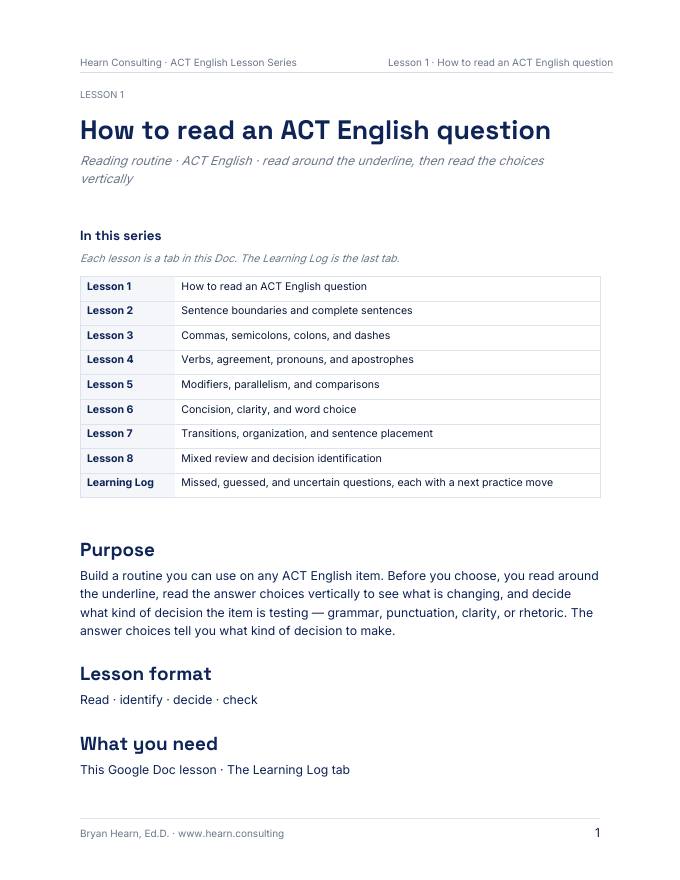
How to read an ACT English question
Build a routine you can use on any ACT English item: read around the underline, read the choices vertically, and name the decision the item is testing before you choose.
Read a free chapter →Self-paced prep for ACT English and ACT Reading.
ACT English rewards editors who decide by meaning, structure, and rule. ACT Reading rewards readers who work from the passage rather than from memory. The Companion teaches both, one skill at a time, with practice and review built in.
What's inside ACT English and ACT Reading only.
Read these first. They explain what the test measures, how it is built, and the routine to use on every question.
Each lesson teaches one transferable skill: instruction, a worked model, a practice set, and an answer key that explains the trap behind each wrong answer.
FreeBuild a routine you can use on any ACT English item: read around the underline, read the choices vertically, and name the decision the item is testing before you choose.
Read a free chapter →Learn to identify complete sentences and choose legal sentence boundaries.
Choose punctuation by structure. Every comma, semicolon, colon, and dash on ACT English follows a rule.
Choose verbs, pronouns, and apostrophes by finding the word that controls the decision. A verb is controlled by its subject and time frame. A pronoun is controlled by its antecedent.
Choose modifiers, parallel items, and comparison structures so they match what they describe or pair with. A modifier must modify the right noun. Items in a list or paired construction must share the same grammatical form.
Choose the answer that removes unnecessary words without removing meaning the sentence needs. Concision items reward clarity, not length.
Choose the answer that fits the logic of the paragraph. A transition must match the actual relationship between the sentences it joins. A new or moved sentence must belong where the paragraph's logic puts it.
Mixed sets that look like the real section. Identify the decision type first — boundaries, punctuation, verbs, pronouns, modifiers, concision, transitions, placement, purpose — then apply the rule.
 Free
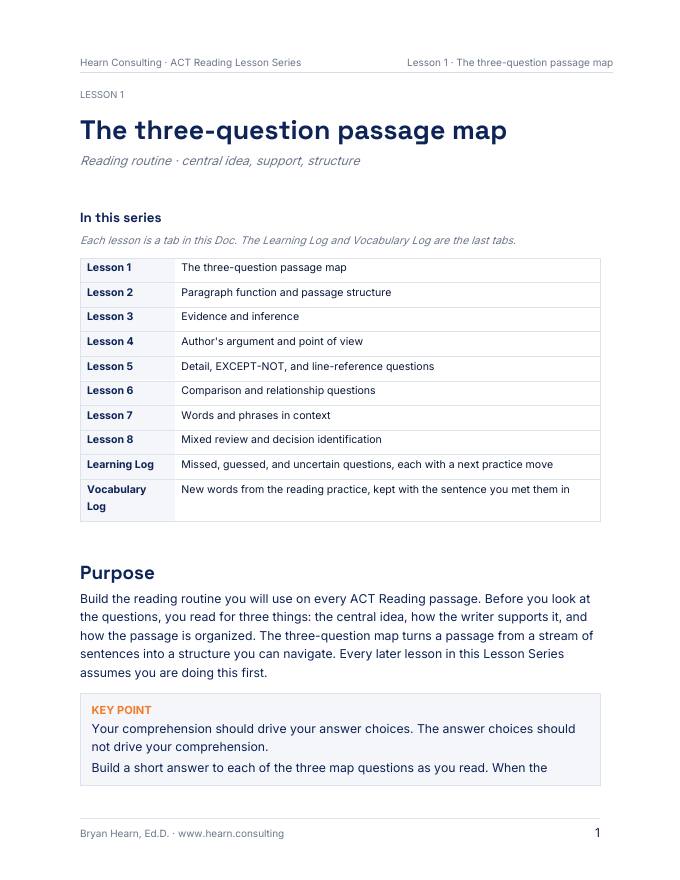
FreeBuild the reading routine you will use on every ACT Reading passage. Before you look at the questions, you read for three things: the central idea, how the writer supports it, and how the passage is organized.
Read a free chapter →Read for what each paragraph does in the passage, not only for what it says. A paragraph's topic is the subject matter on the page; a paragraph's function is the job it is doing in the passage as a whole.
Anchor every inference in specific lines of the passage. An inference is not a guess. It is a claim the passage supports without always saying it in the exact words of the answer choice.
Distinguish what the author of a passage argues from what the author concedes, and distinguish the position the writer takes from the perspective the writing is built from.
Build the habit of checking each answer choice against the passage before you select one. Detail, EXCEPT/NOT, and line-reference items reward the reader who goes back to the text every time.
Map both sides of a relationship before you choose. ACT Reading compares two people, ideas, time periods, or approaches, and traces cause and effect across a passage.
Build the habit of letting context decide what a word or phrase means. ACT Reading often asks you what a familiar word means in a specific sentence, or what a figurative phrase is meant to suggest.
Build the habit of identifying the question type before you answer. Lesson 8 is the closing ACT Reading lesson.
The Mini Diagnostic for a baseline, then every full practice test — each followed by its answer key with a full explanation for every question. Take them under time; the Scores page of the Test Prep Learning Log has a row ready for each one.
Every missed, guessed, or uncertain question gets a row: what the text supported, what you misunderstood, and the next practice move. One tab per test, with drop-downs, a goals page, a scores page, a summary that shows the pattern behind the misses, and a Vocabulary tab for new words from the reading practice. Built into the Companion and available on its own.
Make a copy · PDF · Word listsAnswer inside the lesson and it grades you on the spot, with the trap behind every wrong choice explained — and each miss lands in the Test Prep Learning Log by itself, tagged to the skill it tests. Every lesson in the Companion runs this way. A one-time add-on; it also opens the lessons for the other two tests.
ExampleSample data — each student sees their own.
Read, answer, and get graded on the spot — with the trap behind every wrong answer explained.
Each miss lands in the Test Prep Learning Log, tagged to the official skill it tests, with a concrete next move.
A Google Doc work record saves to your Drive, and every full-length ACT practice test is included in the same account.
The ACT Companion
The Learning Hub
Choose one and the link arrives by email. Adding the Hub to a Companion is a $20 box at checkout; on its own it is a separate purchase. The Companion is also included with eligible 1:1 support — get in touch to talk it through.