 Free
FreeLesson 1
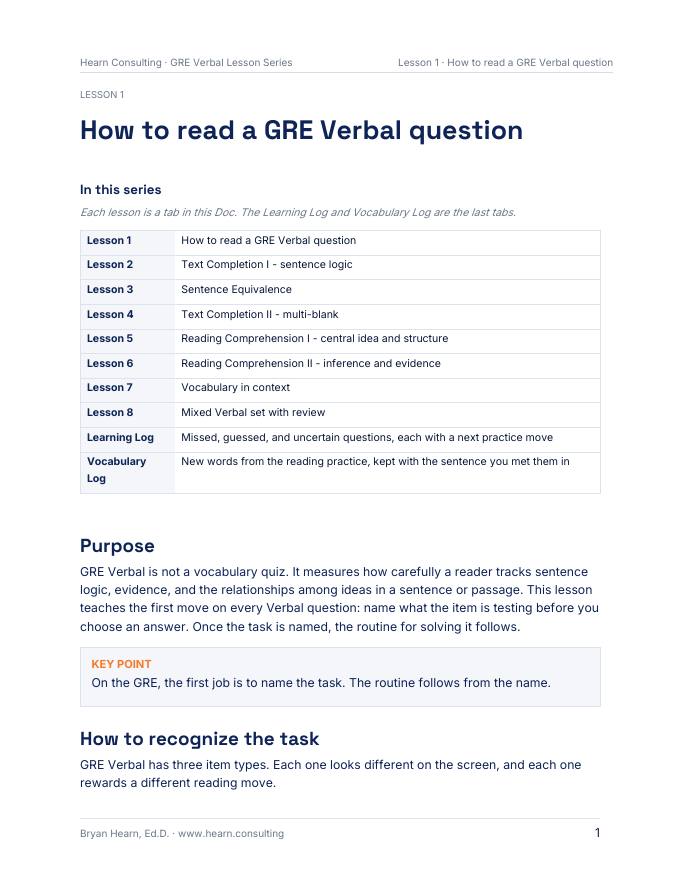
How to read a GRE Verbal question
GRE Verbal is not a vocabulary quiz. It measures how carefully a reader tracks sentence logic, evidence, and the relationships among ideas in a sentence or passage.
Read a free chapter →Self-paced prep for GRE Verbal and Analytical Writing.
GRE Verbal is a reasoning test that uses precise vocabulary; Analytical Writing asks for one clear, well-supported position under time. The Companion teaches both, one skill at a time, with practice and review built in.
What's inside GRE Verbal Reasoning and Analytical Writing only.
Read these first. They explain what the test measures, how it is built, and the routine to use on every question.
Each lesson teaches one transferable skill: instruction, a worked model, a practice set, and an answer key that explains the trap behind each wrong answer.
FreeGRE Verbal is not a vocabulary quiz. It measures how carefully a reader tracks sentence logic, evidence, and the relationships among ideas in a sentence or passage.
Read a free chapter →Single-blank Text Completion is decided by sentence logic, not word familiarity. Find the relationship, predict your own word, then test each choice against it.
Sentence Equivalence items are decided by sentence meaning, not by abstract synonymy. Two words that look like synonyms in a dictionary may produce different meanings when placed in the same sentence.
Multi-blank Text Completion items are not solved one blank at a time in isolation. Each blank has a role in the sentence, and the completed sentence must work as a whole.
Reading Comprehension items reward careful reading of the passage first. This lesson teaches the passage map: a short reading of central claim, how the claim is supported, how the passage is structured, and one-line author purpose.
Reading Comprehension items that test inference, function, or specific evidence are decided by the passage just as central-idea items are. The difference is that the support may be indirect, functional, or tied to a specific line.
Vocabulary in context is decided by reading, not by memorization. A familiar word can carry an unfamiliar academic sense; a connector can shape what a word must mean; the sentence’s tone or register can rule a candidate in or out.
This is the closing GRE Verbal lesson. It does not introduce new content. Instead, it asks one question of every item before you answer it: what kind of Verbal work does this item require?
 Free
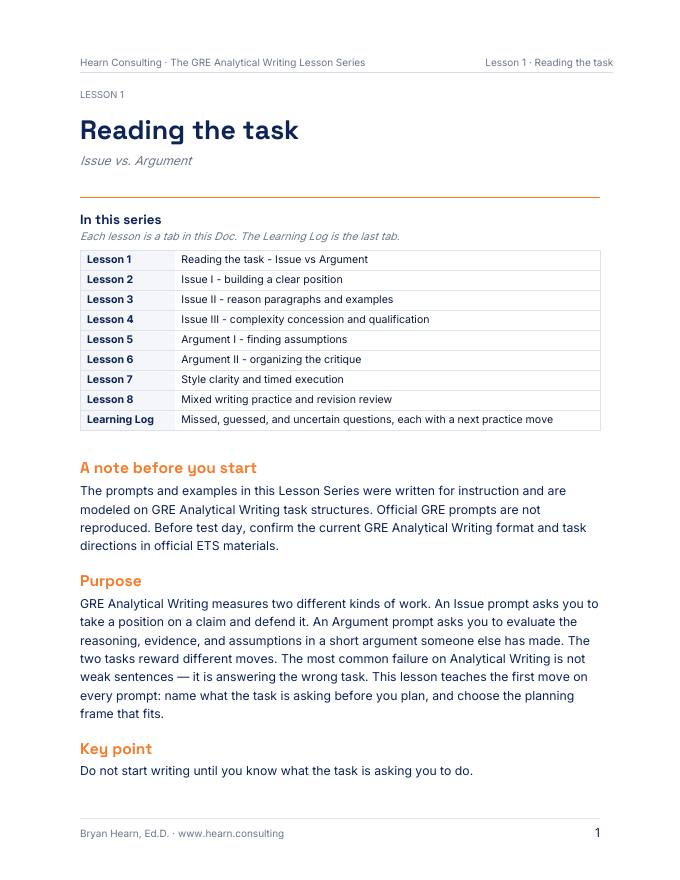
FreeWhat the Issue task asks, how it is scored, and how to read a prompt for the claim, its scope, and the position you are being asked to take.
Read a free chapter →Turn a prompt into a clear, defensible position: a thesis that takes a side, names its grounds, and sets up the paragraphs to come.
Build reason paragraphs that prove the thesis: one reason per paragraph, a specific example, and a sentence that ties the example back to the claim.
A strong Issue essay does not flatten the question. It names limits, exceptions, and the strongest reasonable objection — and then defends the thesis after acknowledging them. This lesson teaches that work.
Argument analysis as reasoning practice: name the conclusion, the evidence, the assumptions the argument depends on, and what would strengthen or weaken each.
Organize a critique: order the assumptions by how much the argument depends on them, and write paragraphs that explain the gap rather than list it.
Execution under time: a plan you can write in three minutes, sentence-level clarity, and the small style choices that keep a reader with you.
Mixed timed practice with a revision review: score each essay against the rubric, name the pattern in your misses, and set the next practice move.
The Mini Diagnostic for a baseline, then every full practice test — each followed by its answer key with a full explanation for every question. Take them under time; the Scores page of the Test Prep Learning Log has a row ready for each one.
Every missed, guessed, or uncertain question gets a row: what the text supported, what you misunderstood, and the next practice move. One tab per test, with drop-downs, a goals page, a scores page, a summary that shows the pattern behind the misses, and a Vocabulary tab for new words from the reading practice. Built into the Companion and available on its own.
Make a copy · PDF · Word listsAnswer inside the lesson and it grades you on the spot, with the trap behind every wrong choice explained — and each miss lands in the Test Prep Learning Log by itself, tagged to the skill it tests. Every lesson in the Companion runs this way. A one-time add-on; it also opens the lessons for the other two tests.
ExampleSample data — each student sees their own.
Read, answer, and get graded on the spot — with the trap behind every wrong answer explained.
Each miss lands in the Test Prep Learning Log, tagged to the official skill it tests, with a concrete next move.
A Google Doc work record saves to your Drive, and every full-length GRE Verbal practice test is included in the same account.
The GRE Companion
The Learning Hub
Choose one and the link arrives by email. Adding the Hub to a Companion is a $20 box at checkout; on its own it is a separate purchase. The Companion is also included with eligible 1:1 support — get in touch to talk it through.